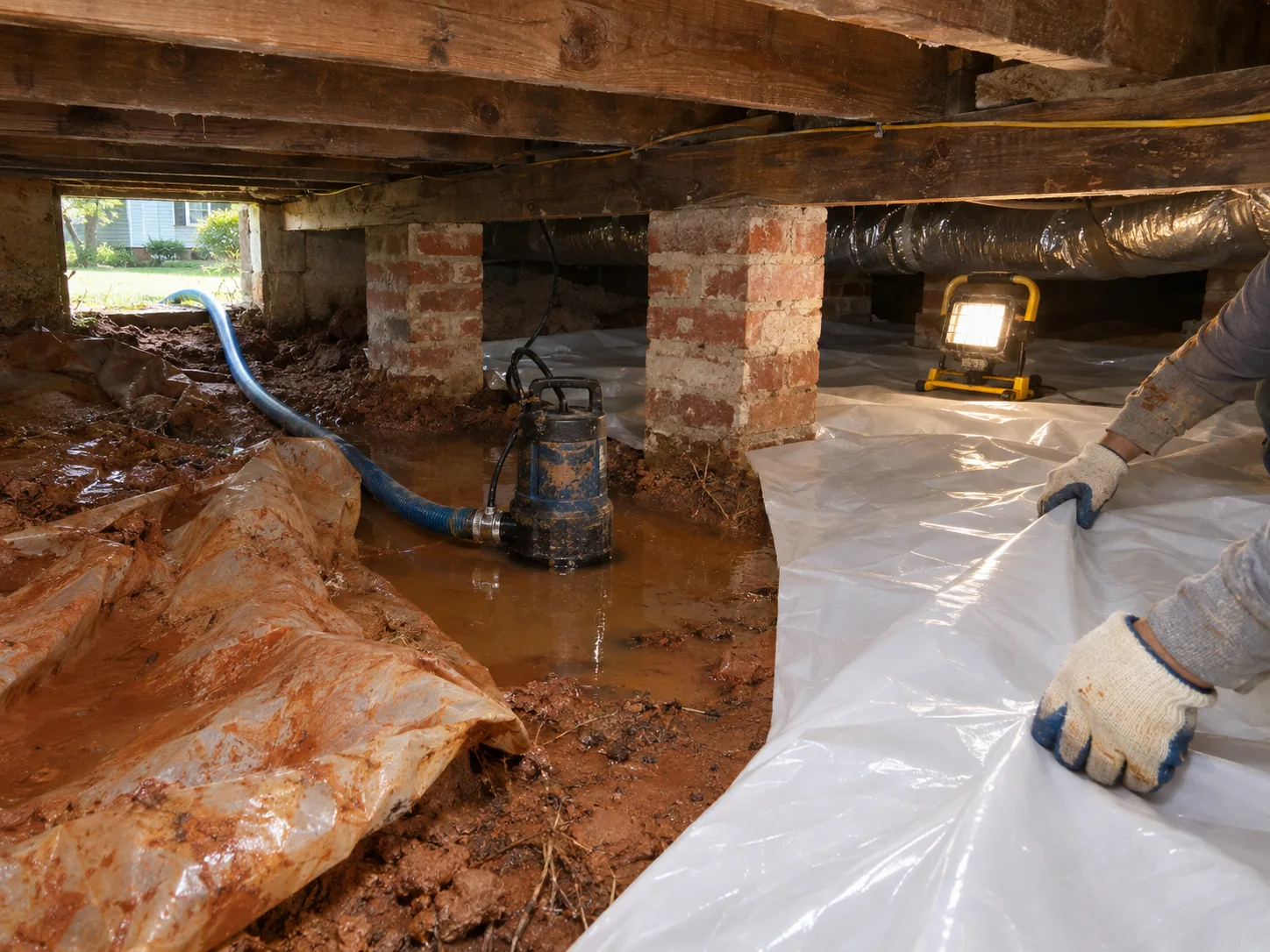
Macon County construction is crawl-space country. Walk any neighborhood in Tuskegee, Franklin, Zion Hill or over in Shorter and you'll see almost no basements, just vented crawl spaces with red clay or vapor-barrier ground cover. When a supply line breaks on a first floor or a storm pushes water through a crawl-space vent, most of that water ends up under the home sitting on batt insulation that's holding it against the joists.
The problem with slow red-clay drainage is water does not go away in Macon County, it sits. We've pumped crawl spaces three days after a Gulf storm that still had 2 inches standing in the low corner. Vapor-barrier helps but when it fails or wasn't there, groundwater just wicks up through the clay for weeks. The right cleanup pulls the water, bags the saturated insulation, dries the subfloor and joists with directed air movement, and re-vapor-barriers the ground before we close it back up.
The handful of older Tuskegee homes with true basements, mostly 1920s to 1950s stock near Court Square, take water differently. Groundwater through the block wall after a saturating rain, failed sump pump, or a sewer line that backed up through the floor drain. Each gets its own approach, but the principle holds, pull the water, remove what's unsalvageable, dry the structure, and verify with a meter before the equipment leaves.
What we handle
Crawl-Space Pump-Out
Standing water pumped from under the home with submersible and transfer pumps. Red-clay sediment removed as needed before drying starts.
Saturated Insulation Removal
Wet batt insulation bagged and hauled. Hanging and failed batts the biggest source of mold risk in Macon County crawl spaces, pulled before drying.
Joist and Subfloor Drying
Directed air movers from below, dehumidifier pulling the moisture out. Drying continues until floor joists and subfloor read dry on a meter, usually 4 to 7 days in clay-bottom crawl spaces.
Vapor Barrier Replacement
Failed or missing ground vapor barrier replaced with 6-mil polyethylene, seams overlapped and taped so groundwater does not wick up through the clay again.
Antimicrobial Treatment
EPA-registered antimicrobial applied to joists, subfloor and foundation walls after drying. Helps hold the space clean while the HVAC and dehumidifier catch up.
Basement Water Mitigation
For the older Tuskegee homes with true basements. Water extraction, drywall and insulation cuts, flooring pulled, waterproofing recommendation to prevent next event.
Sump Pump Install Recommendation
Where the crawl space holds water repeatedly, we scope a sump pit and pump install through a trusted local plumber. Not required for all homes, right for low-lying lots.
How the job goes
1. Access and Inspection
Crawl-space access located, flashlight and meter down. Standing water measured, insulation inspected, joists and subfloor checked for moisture content.
2. Pump Out and Bag
Transfer pumps drop water to grade or storm drain where allowed. Saturated insulation bagged under the home and hauled out. Ground cleared before drying starts.
3. Drying Setup
Air movers staged under the home or through crawl-space vents, dehumidifier up top pulling moisture through. Daily meter readings logged.
4. Vapor Barrier and Close Up
After the subfloor reads dry, new 6-mil polyethylene laid on the clay, seams lapped and taped. Access covered and the space handed back clean.
What's included
- Crawl-space access and inspection
- Submersible pump-out of standing water
- Bagged removal of saturated batt insulation
- Directed air mover and dehumidifier drying
- Daily moisture meter readings
- EPA-registered antimicrobial on joists and subfloor
- New 6-mil vapor barrier installed
- Photo documentation for insurance
What it costs
Most crawl-space water cleanup jobs run $1,500 to $6,000 depending on water volume and insulation square footage. True-basement jobs on older Tuskegee homes run $2,500 to $9,000.
| Job | Typical price | Notes |
|---|---|---|
| Crawl-space pump-out | $500 to $1,800 | Based on water volume |
| Saturated insulation removal | $800 to $2,200 | Bagged and hauled, per home |
| Standard crawl-space water cleanup | $1,500 to $6,000 | Includes drying and vapor barrier |
| True-basement water cleanup | $2,500 to $9,000 | Rare in Macon County, older homes |
| New 6-mil vapor barrier | $800 to $2,500 | Full crawl-space coverage |
Ranges are typical for Basement and Crawlspace Water Cleanup jobs in Tuskegee and confirmed with an exact written quote before any work starts.