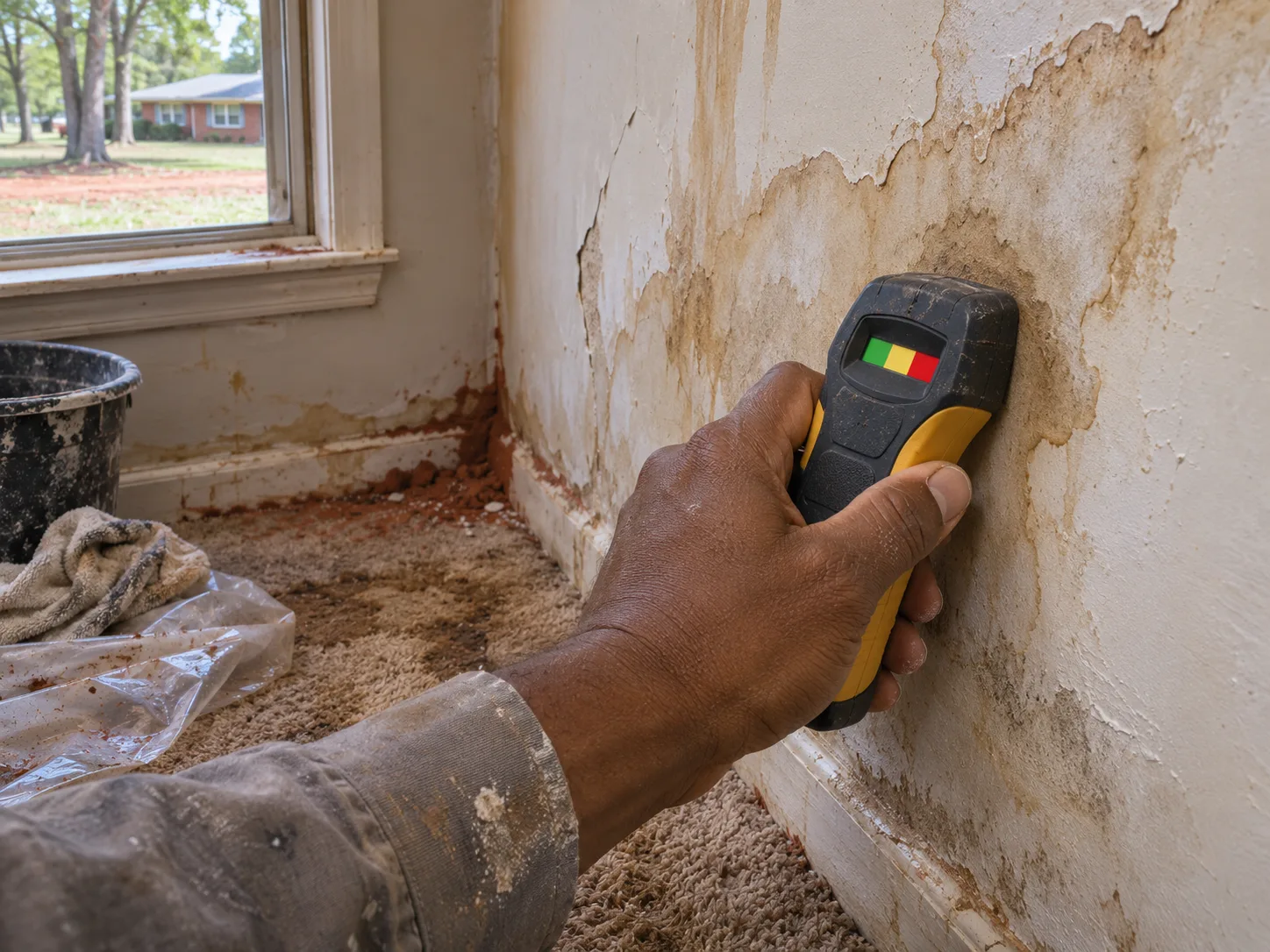
Most water losses in Tuskegee fall into four buckets: a supply line let go overnight, a dishwasher or water heater failed, a roof took on a storm, or a Gulf system parked over Macon County and pushed water under the door. On a clean-water Category 1 job we extract, run air movers and dehumidifiers, and verify drying with a moisture meter every 24 hours. On dirty Category 2 or sewage Category 3 we cut and bag the affected material first because you can't dry contamination back to healthy, you have to remove it.
Macon County is crawl-space country, almost no basements. When water hits the floor of a 1940s wood-frame bungalow off Franklin or a brick ranch over in Greenwood, a lot of it ends up in the crawl space insulation and on the floor joists. That's the hidden part of the job most out-of-town shops miss. We pull crawl-space access, check under every wet room, and bag the batt insulation that's holding moisture because red clay down there drains slow and the humidity just sits.
Spring and fall thunderstorms are our busiest windows, and every 2 or 3 years a Gulf tropical system drops 4 to 8 inches of rain on east-central Alabama in a night. After a named system we stage extra trucks and crews for 72 hours because the queue builds fast. If you're calling after a storm, call early, get on the list, and we'll triage by severity, active leaks and whole-house floods first.
The mistake we see most from cheap operators is a 3-fan drying plan on a 6-fan job and an extra 3 days on the clock to pad the bill. We size the drying plan to the actual square footage of wet material and the actual moisture readings, not to a flat-rate rental schedule. Every job gets a daily moisture log, and we leave when subfloor, framing and joists read dry per standard, not a day later.
What we handle
Emergency Water Extraction
24/7 standing-water extraction for burst supply lines, failed appliances, roof leaks and storm flooding across Tuskegee, Notasulga, Shorter and Opelika. Truck-mount and portable units sized to the loss.
Structural Drying
Air mover and dehumidifier placement calculated to the square footage of wet material. Moisture meter readings logged every 24 hours until framing, subfloor and drywall cavities read dry per standard.
Crawl-Space Water Cleanup
The big one in Macon County. We pull soaked batt insulation, dry joists and subfloor from below, treat for microbial growth, and re-vapor-barrier the crawl space before we close it back up.
Wet Drywall and Insulation Tear-Out
Flood-cut drywall at 24 inches above the water line, bagged insulation hauled off, studs and bottom plates dried and treated. Documented with photos and moisture readings for your adjuster.
Hardwood and LVP Floor Drying
Mat-drying systems for site-finished oak and engineered LVP floors in older Tuskegee bungalows and Greenwood ranches. Saves the floor when we catch it in the first 48 hours.
Contents Pack-Out and Dry
Wet furniture, boxes and personal items inventoried, photographed, pack-out to dry storage. Returned clean and dry after the structure finishes.
Insurance Documentation
Daily moisture logs, photo documentation of every wet material, written scope and sketch handed to the adjuster so the claim moves in days, not weeks.
Rebuild Coordination
Drywall, flooring, paint and trim rebuild handed off to trusted local trades or coordinated through us. Pulled permits through Macon County or the Tuskegee city office where required.
How the job goes
1. Phone Intake
You call, we ask 4 or 5 quick questions. Source of water, how long, clean or dirty, how many rooms, is power safe. You get a likely scope, a price band, and a truck ETA inside 2 hours for Tuskegee and Macon County.
2. Inspection and Moisture Map
Crew arrives, moisture meter out, crawl space checked, every wet wall and floor cavity mapped and photographed. Inspection runs 30 to 60 minutes.
3. Written Scope
You see the extraction, tear-out, drying plan, and the price on paper before any fans come out. Insurance paperwork handed to you or faxed to the adjuster same day.
4. Extract, Dry and Monitor
Standing water pulled, affected material removed, air movers and dehumidifiers staged. Moisture readings logged daily. Drying runs 3 to 7 days depending on category and square footage.
5. Final Moisture Report
Framing, subfloor and drywall cavities verified dry per standard. Final photos, final moisture log, written warranty and invoice handed over. Rebuild quote if you want it.
What's included
- 24/7 live phone intake with price band and ETA
- On-site moisture map and photo documentation
- Written scope and drying plan before work starts
- Truck-mount or portable water extraction
- Air movers and commercial dehumidifiers sized to the loss
- Daily moisture meter readings logged
- Flood cuts, tear-out and bagged haul-off of wet materials
- Crawl-space insulation removal and treatment
- Antimicrobial treatment on affected framing
- Written final moisture report and warranty
What it costs
Small single-room jobs run $500 to $2,500. Medium multi-room jobs run $2,500 to $7,500. Whole-home or storm-flood jobs run $7,500 to $25,000 or more. $300 to $600 emergency response fee rolls into the job if you hire us.
| Job | Typical price | Notes |
|---|---|---|
| Emergency response fee | $300 to $600 | Rolls into the job if you move forward |
| Small single-room water job | $500 to $2,500 | Clean Category 1 water, under 200 sq ft |
| Medium multi-room water job | $2,500 to $7,500 | 2 to 3 wet rooms, includes tear-out |
| Whole-home flood or storm | $7,500 to $25,000+ | 4+ rooms, Category 2 or 3, extended drying |
| Crawl-space insulation removal | $800 to $2,200 | Per home, includes antimicrobial treatment |
| Contents pack-out and dry | Quoted on site | Based on volume and item condition |
Ranges are typical for Water Damage Restoration jobs in Tuskegee and confirmed with an exact written quote before any work starts.